Showing posts with label bogdanovich. Show all posts

Wednesday, March 26, 2014

The Bogdanovich Challenge: Week Twelve


THE FILM:

Heaven Can Wait, released August 11, 1943.

Directed by Ernst Lubitsch.

Starring Gene Tierney, Don Ameche and Charles Coburn.


PETER BOGDANOVICH SAYS:
"One of the master's most wonderful and representative films, one that should be seen by anybody who craves real quality or needs to be convinced that there has been a general dumbing down of our popular entertainment, is Lubitsch's penultimate film. Appropriately, the 1943 Techniolor production HEAVEN CAN WAIT is a look at the inevitability of death and a meditation on the rewards and punishments of the afterlife, all part of a funny and profoundly human chronicle of an unimportant man's life."

THE TRASH MAN SAYS:

A wonderful, charming and poignant look at growing old and mortality.


Henry van Cleeve (Don Ameche) finds himself at the Gates of Hell, face-to-face with His Excellency, arguing not why he should be spared an eternity of brimstone and hellfire, but instead why he should be admitted. The only way he knows how is to tell the tale of his life; which he begins as a spoiled, pampered child of privilege; bribing young girls with beetles and sipping champagne with his family's French-maid. Oh, and at twenty-six, he steals away his cousin's fiance, Martha (Gene Tierney), running off to elope on the very same day they met.

Love, in the truest sense of the word, manages to change Henry from a womanizing cad to a loyal husband and father. But there's still a lingering presence of his former silver-tongued self, which begins to emerge more and more as his hair begins to grey and his tummy begins to grow. Despite the occasional missteps, however, Martha stands by her husband's side.

Until the day she dies.

Leaving poor Henry alone with his son, Jack, and eventually his son's wife. Nearly two decades pass by in a flash, giving us only a few glimpses into the loneliness and pathos of a man who has always had a difficult time with growing older and his eventual demise. Perhaps it's because he feels like he deserves an eternity in Hell, away from the people who he loved and who loved him in return. A vague guilt for past indiscretions that he'd already been forgiven for.

Or it could be that Henry simply loved life too much to want to slow down, to watch years waste away to nothing in silence. It certainly explains why, on his death-bed, he still dreamed of young, beautiful blonde girls and a river of whiskey and turning away Death for appearing in a canoe and not a luxury cruise-liner.

Wednesday, March 19, 2014

The Bogdanovich Challenge: Week Eleven


THE FILM:

The Quiet Man, released August 14, 1952.

Directed by John Ford.

Starring John Wayne, Maureen O'Hara, Barry Fitzgerald and Ward Bond.


PETER BOGDANOVICH SAYS:
No words, however, can convey the joyous exuberance of THE QUIET MAN, its visual grace, the wonderful love of humanity it projects. Barry Fitzgerald's performance alone as the "matchmaker" carries much of the leprechaun-like magic and poetic mystery Ford brings to the tale. It is, too, a film for the whole family, before ratings were necessary, that is thoroughly clear for adults in its adult meanings, yet innocently enjoyable for children.

THE TRASH MAN SAYS:

Back when I was younger, I used to claim that my favorite John Wayne flick was Sands of Iwo Jima (1949), because Wayne gets shot and killed by a sniper.

Yeah, I was a pretty stupid kid.

Here, as Sean Thornton, recently returned to the small Irish village where he was born, Wayne is totally likable. There's the element of culture shock; he's a fish-out-of-water, unsure how to go about courting the fiery red-head, Mary Kate Danaher (played by Maureen O'Hara), or how to keep her happy when he finally does win her over. But he's an honorable man, refraining from giving in to violence and more concerned with the simpler things in life over material wealth. Of course, he's not above giving his bride a good pat on the bottom, and constantly lighting up cigarettes. Slamming doors and stealing kisses [and tandem bikes] and knowing when he absolutely must stand-up for the people he loves.

The real star here is Ireland itself, though. Most of the outdoor scenes were shot there, and they are gorgeous. The luscious green landscapes are breath-taking; they're worth the price of admission alone.

Like many of the films I've watched so far for the Challenge, this one serves as a proper introduction for yours truly to the works of another prolific director; this time it's John Ford. I had seen bits and pieces of The Man Who Shot Liberty Valance (1962) years ago, but The Quiet Man marks his first film that I've watched from beginning to end. Odd, though, that I'd start with one of his few collaborations with John Wayne that wasn't a western.

That will soon change, however, when The Bogdanovich Challenge hits Week Twenty-Two.

Wednesday, March 12, 2014

The Bogdanovich Challenge: Week Ten


THE FILM: 

The Miracle of Morgan's Creek, released January 5, 1944.

Directed by Preston Sturges.

Starring Eddie Bracken, Betty Hutton, Diana Lynn and William Demarest. 


PETER BOGDANOVICH SAYS:

"Not only are all the performances top-notch but there's that flawless comic rhythm that is uniquely Sturges--his stock company certainly knew his beat--like a conductor with his own orchestra. This was especially important with Sturges, who created all his scripts by improvising them for his secretary to write down."

THE TRASH MAN SAYS:

Writer/director Preston Sturges makes his second appearance on Bogdanovich's list of 52 essential films for the year with The Miracle of Morgan's Creek (1944). Another screwball romantic comedy, this time dealing with a promiscuous party-girl, Trudy (Betty Hutton), who ends up married to The Unknown Soldier. Or, well, close enough. Maybe his name is actually Ratzkiwatzki or something else with a Z in it, she's not really sure. Complicating matters, Trudy quickly discovers that the fun-filled night of dancing, drinking and blacking out also left her fun-filled with child.

So, she does the honorable thing and tries to conceal the truth by convincing a stupid, stuttering bank-teller by the name of Norval Jones (Eddie Bracken) to propose, wed, and claim to be the father-to-be. Norval, madly in love with Trudy, is willing to do whatever it takes to protect her and hopefully win her heart and her hand for real. Naturally, things escalate and matters become even more complicated and comical from there.

The climax involves bank robberies, Sturges' regular William Demarest wrestling a cow, and Adolf Hitler.

I'll admit that I'm amazed at the subject matter that's presented, and for comedic-effect no less, in a film from the mid-Forties. The concept of an expected mother, one who doesn't even know the identity of the true father, as the film's protagonist seems pretty novel for a film from the Golden Age of Cinema. Doubly impressive was Trudy's whip-smart and sarcastic kid sister, Emmy (Diana Lynn), who runs circles around the rest of her family and the rest of the cast.

Wednesday, March 5, 2014

The Bogdanovich Challenge: Week Nine


THE FILM: 

The Blue Angel, released April 1, 1930.

Directed by Josef von Sternberg.

Starring Emil Jannings, Marlene Dietrich and Kurt Gerron. 


PETER BOGDANOVICH SAYS: 
"The amazing chiaroscuro photography, the clothing, the decor, the atmosphere: with Dietrich at her least sentimental, Jannings at his most naked, everything conspires to make THE BLUE ANGEL an indelible screen tragedy."

THE TRASH MAN SAYS:

It's not enough that I've taken to watching the man's film selections every single week. Now, I had to look up the definition of "chiaroscuro", so thanks a bunch, Bogdanovich. If I really wanted an education, I would have paid attention in school.

I should have been paying closer attention to this particular entry from the get-go, though. While visually it reminded me of my brief infatuation with German Expressionism, films like Nosferatu (1922) and Das Cabinet des Dr. Caligari (1920), the tone of The Blue Angel was a little too light for my taste. Sure, there was an emphasis of light and shadows, a staple of early German cinema and the "film noir" genre, but a bumbling professor (Emil Jannings) teased by his students, knocking things over and being referred to as "Professor Garbage" didn't really catch my attention.

Of course, then he meets and falls in love with a saucy cabaret dancer named Lola-Lola (Marlene Dietrich), and everything starts to fall apart. Things stop being light and funny, and you'll bear witness to the lows that a man will sink to in order to win a woman's heart. And when that same woman, now the Professor's wife, finds it more and more difficult to stay faithful to her husband, that man will break. Completely and utterly, until all that's left is Der Clown; lost to the shadows and wallowing in the dredge and depravity that was once his life.

Tuesday, February 25, 2014

The Bogdanovich Challenge: Week Eight


THE FILM: 

Notorious, released August 15, 1946.

Directed by Alfred Hitchcock.

Starring Cary Grant, Ingrid Bergman and Claude Rains. 


PETER BOGDANOVICH SAYS:

"For an absolutely unique, no-apologies. no-excuses, first-rate picture, Alfred Hitchcock's 1946 suspense success, NOTORIOUS, is the one. It is a more-modern-than-ever. ambiguous and troubling, love-versus-duty story of the early noir era: a convicted Nazi's innocent daughter (Ingrid Bergman at her most striking), wholly in love with an American spy (Cary Grant) who's divded about her, is forced to marry a renegade Nazi (Claude Rains) who's truly mad about her."
"It is arguably Hitchcock's best film, with a brilliant script (nominated for an Academy Award) that he concocted with the ace Ben Hecht."

THE TRASH MAN SAYS:

Slow, sorta' dull.

I might have to mark these week's entry in the Challenge down as a failure. My familiarity with Hitchcock's work bends more to his later-era work; the darker (Rear Window, Strangers on a Train) and the far more depraved (Psycho, Frenzy). Oh, and The Birds (1963), of course. This one, well, this one I would argue with Bogdanovich is far from the best from The Master of Suspense.

I'm going to have to revisit it sooner rather than later, though. To give it a fair chance to redeem itself in the eyes of a sluggish Trash Man. Yeah, I had difficulty staying awake thanks to an early morning shift at work, which is maybe no fault of the film's. But with only a few hours left in the day, and the week-long window to watch and review the film, I don't have it in me to attempt a re-watch before the deadline's up.

Sorry, Hitch. I'll see you again in Week Fifteen, and hopefully then I'll be a lot less groggy.

Tuesday, February 18, 2014

The Bogdanovich Challenge: Week Seven


THE FILM:

Adam's Rib, released November 18, 1949.

Directed by George Cukor.

Starring Katharine Hepburn, Spencer Tracy, Judy Holliday and Tom Ewell.


PETER BOGDANOVICH SAYS:
"Of the nine Tracy-Hepburn vehicles shot during the quarter century between 1942's WOMAN OF THE YEAR (directed by George Stevens) and 1967's GUESS WHO'S COMING TO DINNER (directed by Stanley Kramer), I'd put ADAM'S RIB at the top. The real Manhattan locations certainly help to give it the edge, as does the basic premise--unbeatable in male-female conflict--not to mention Judy Holliday's scene-stealing performance, filmed while she was already wowing Broadway audiences as the lead in Garson Kanin's hit play, BORN YESTERDAY."

THE TRASH MAN SAYS:

Finally, some familiar faces.

I'm no stranger to Hepburn-Tracy joint flicks, having previously seen 1952's Pat and Mike (also directed by George Cukor) and Desk Set (1957). The latter was my first introduction to the pair, having caught it on AMC back when they used to show actual "classic" films without commercial interruptions. This film, Adam's Rib, was their sixth together, and might be my favorite so far. Their on-screen chemistry is undeniable; it's easy to see why they were cast together so frequently and often at odds.

Here they portray a married couple, Adam and Amanda Bonner, rival lawyers whose court-case of a spurned wife who shot her cheating husband explodes into a near-literal battle of the sexes. What starts out as playful courtroom behavior quickly spirals out of control, threatening to tear apart their own seemingly blissful marriage. With neither one willing to back down, it seems that the only way the story can end is with their eventual divorce. Or a possible murder.

Hilarity ensues!

It really is a wonderful and clever film, though it's odd that Bogdanovich would have listed it as essential Valentine's Day viewing material. Sure, there's romance and comic misunderstandings that teeter on the brink of true turmoil, and the occasional dose of slapstick and one absolutely hilarious sight-gag at the beginning of the film. But I have to believe that there are far more suitable romantic comedies from the golden age of Hollywood than this one. Perhaps I'll even find one as a I continue this year-long endeavor.

Oh, and I absolutely adored Judy Holliday as Doris Attinger, the spurned wife. During her time on the witness stand, I was immediately struck with how similar her character's voice and mannerisms were to those of the infamous Bat-rogue, Harley Quinn. I've read other comparisons between Harley and one of Holliday's later roles in the film, Born Yesterday.

Tuesday, February 11, 2014

The Bogdanovich Challenge: Week Six


THE FILM:

White Heat, released September 2, 1949.

Directed by Raoul Walsh.

Starring James Cagney, Virginia Mayo, Margaret Wycherly and Edmond O'Brien.


PETER BOGDANOVICH SAYS:
"WHITE HEAT both revived Warner Brothers' gangster cycle of the Thirties and also ended it conclusively for the golden age, which still had about thirteen years to go. In other words, this is the climax of the gangster genre."

THE TRASH MAN SAYS:

The Bogdanovich Challenge has allowed me the opportunity to view several films I otherwise would have ignored. That's an embarrassing thing to admit, because every single selection has been solid. There's not a single one of the first six movies that I haven't fully enjoyed. Likewise, there are performers, actors who I knew only through reputation or through references or caricatures, that I've only just discovered.

James Cagney is absolutely one of the finest.

His performance here as Cody Jarrett is fantastic. He's a psychotic mama's boy that is always on the verge of a complete and utter breakdown. There are glimpses early on, with his violent outbursts and his lack of concern for the well-being of any other human being besides himself and his mother. The only time he appears to do the right thing, like turning himself in to the authorities, is when he's trying to protect himself from a far worse fate.

And yet.

And yet, you're going to watch White Heat and you're gonna sorta' root for him to get away with every horrible thing that he's done. Sure, you'll be waiting for his eventual meltdown, you'll cringe when his wife, Verna [played by Virginia Mayo], cringes any time Jarrett raises his hand, but there's this little part of you that will cheer when he gets revenge on the goons who betrayed him.

Bogdanovich shared an anecdote in his book; he and Orson Welles viewing the film sometime in the '70s together and booing the undercover cop (Edmond O'Brien) who's wormed his way into Jarrett's gang.

You'll be booing, too.

Tuesday, February 4, 2014

The Bogdanovich Challenge: Week Five


THE FILM: 

Anatomy of a Murder, released July 1, 1959.

Directed by Otto Preminger.

Starring James Stewart, Lee Remick, Ben Gazzara, Eve Arden and George C. Scott. 


PETER BOGDANOVICH SAYS:

"In 1959-- when Frank Sinatra and Elvis Presley and Marilyn Monroe were red-hot --one of the finest and most important American films was released, did well, won an award or two (like the New York Film Critics' selection of James Stewart as best actor), and then passed from the scene. But it should be required viewing for anyone who cares about true quality in picture-making, America's complicated judicial system, and life's generally ambiguous pathways."

THE TRASH MAN SAYS:

Jimmy Stewart is the "humble country lawyer" who smokes Italian cigars, like Eastwood in a spaghetti-western, and who hangs out with Duke Ellington, playing jazz music on the piano. This walking contradiction has to defend Ben Gazzara, who killed the man that brutally raped his wife. And he has to do it while facing off with the slick, city lawyer portrayed by George C. Scott.

I'm still trying to fully absorb how goddamn brilliant this film really is. Every aspect, from the performances to the cinematography to Ellington's unique score, is mind-blowing. To hear Stewart utter the phrase, "sexual climax" in a film from 1959. Insanity. Yes, a majority of the movie takes place within the confines of the court-room, and it plays out like watching an extended episode of Law & Order, but it's so much more than that. It's easy to see why Bogdanovich speaks so highly of it; why he believes it should be "required viewing".

Oh, and because of the inventive opening title sequence and gorgeous posters by Saul Bass, I mistakenly believed that Hitchcock directed Anatomy of a Murder for years. It wasn't until reading this entry in Bogdanovich's book, and ordering the film on Amazon, that I learned how wrong I was. It's completely unrelated from the Challenge [though inspired by this week's selection], but I'm definitely going to be seeking out director Otto Preminger's earlier film, The Man with the Golden Arm (1955).

Tuesday, January 28, 2014

The Bogdanovich Challenge: Week Four


THE FILM:

To Have and Have Not, released October 11, 1944.

Directed by Howard Hawks.

Starring Humphrey Bogart, Lauren Bacall, Walter Brennan and Dolores Moran.


PETER BOGDANOVICH SAYS:
"The resultant 1944 movie, starring Humphrey Bogart and Lauren Bacall, is probably the best love-story-and-foreign-intrigue picture ever made. In the same genre, I much prefer To Have and Have Not to the more famous Casablanca, and I watch it more often, not least because it has a happy ending."

THE TRASH MAN SAYS:

No kissing, Frenchy.

It took a little while into its run-time, but To Have and Have Not won me over by the film's end. A little too reminiscent of Casablanca to start, a film I attempted to watch back in high school and couldn't quite get through. Bogart always a little too too-cool-for-school, smoking in every scene and only calling Lauren Bacall things like "Slim" and "Junior" to the point where you wonder if she has a real name at all. He's a jack-of-all-trades, equally good at fishing and tending to bullet wounds, and always with something dry and sharp in response to everything said to him.

But then he loses his cool during the third-act and pulls a gun, and I'm completely won over. This is the Bogart I wanna see more of; hand shaking after gunning down a Vichy goon, making angry and violent threats. Gone is the carefree and cool, replaced by a bastard who will do anything to protect the people who matter most to him.

Lauren Bacall, too, is a wonder to watch. She was only nineteen when the film was made, but her character Marie appears years older and more together than others twice her age. It's easy to see how Harry Morgan (Bogart) and the actor himself both fell for her. And the two would appear together in another of director Howard Hawks' films, the noir thriller, The Big Sleep, which was released two-years after this one.

Tuesday, January 21, 2014

The Bogdanovich Challenge: Week Three


THE FILM:

The Awful Truth, released October 21, 1937. 

Directed by Leo McCarey. 

Starring Irene Dunne, Cary Grant, Ralph Bellamy and Alexander D'Arcy.


PETER BOGDANOVICH SAYS:

"Certainly among the great American comedies, this remains as remarkably fresh and buoyant as ever--more so. It has, too, an adult kind of witty sophistication that is perfectly representative of the best aspects of the glorious Thirties. How did we ever get so dumbed down to the prevalent sophmoric humor of the Nineties?
The Awful Truth is perhaps the supreme example of light comedy that's also real, human, and mature in dealing with man's often frivolous idiosyncrasies and foolishness."

THE TRASH MAN SAYS:

Of the three films that I've watched so far for this year-long challenge, The Awful Truth is the earliest released and easily my favorite.

It's amazing to think that this was Cary Grant's first real leading role, because the man is brilliant as the recently separated Jerry Warriner. He's charming in a way that doesn't quite seem possible; a little weaselly at first, but it's difficult not to let him win you over by the film's end. Even when it's his own dishonesty and distrust that destroyed his marriage in the first place. Even when he's openly sabotaging his soon to be ex-wife's new romance. It's no surprise that Grant and the word great are only a few letters off.

Actually, forget I said that last bit. What a stupid thing to say.

The real surprise is that actress Irene Dunne never received an Academy Award, despite being nominated on five separate occasions for Best Actress. That includes one for this film, where she portrays Grant's wife, Lucy Warriner.  Their chemistry together is fantastic, sure, but Dunne isn't just a pretty face for Cary to play off of. She's perfect in every scene she's in. I was impressed with how well she pulls off the comedic, but doubly so by one well-placed dramatic delivery in the final act. It's a wonderful little moment that reminds the viewer that, despite all the shenanigans and word-play, there's actually something at stake for these two former lovers.

Bogdanovich was spot-on when he referred to The Awful Truth as fresh. Even though the film is over seventy-five years old, it rarely feels dated. Definitely one that I'll be revisiting sooner rather than later.


Tuesday, January 14, 2014

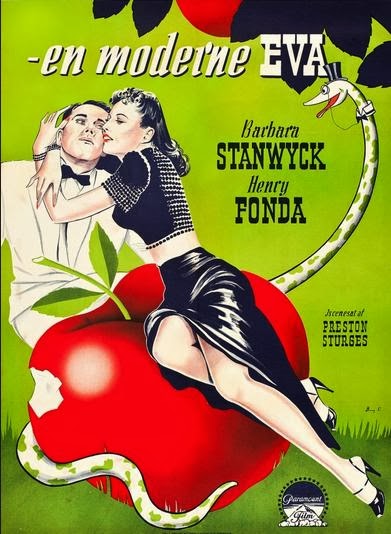
The Bogdanovich Challenge: Week Two


THE FILM:

The Lady Eve, released February 21, 1941.

Directed by Preston Sturges.

Starring Barbara Stanwyck, Henry Fonda, Charles Coburn, William Demarest and Eugene Pallette.


PETER BOGDANOVICH SAYS:

"Exhilarating fast-paced and surprisingly complicated, The Lady Eve has numerous snake-like twists, and the sophisticated moral view that emerges is also neither predictable nor easy, as it never was in Sturge's best work. The dame may be wrong, but the guy turns out to be more wrong until he learns his lesson: the battle of the sexes is an uneven one in many ways--woman having the advantage over the long haul."

THE TRASH MAN SAYS:

Another solid pick by Bogdanovich.

This movie marks my personal introduction to the work of writer/director Preston Sturges, and if the rest of his filmography holds up as well as this, I'm going to have to seek out more. While hardly breaking new ground with camera-work, it's the whip-smart dialogue that really shines here. Sturges' strength really does lie within his writing, and it's brilliantly delivered by the film's all-star cast.

Henry Fonda's portrayal as Charles Pike, the naive and absent-minded ophiologist, is perfect. Some might mistake his performance as wooden; he's stiff when necessary, sure, but has no problem handling all the slapstick comedy that permeates the film's later scenes. He also has no trouble keeping pace with his leading lady co-star, Barbara Stanwyck.

It would be impossible to discuss The Lady Eve, even on the most basic of levels, without talking about Stanwyck. As the sultry con-artist, Jean Harrington, she almost literally steals every single scene that she's in. There is little doubt that she's always in control; whether it's seducing [and later falling in love with] Charles or out-smarting her conniving father (Coburn), it's obvious who is running the show. And, like Sturges, this was the first time I've watched one of Stanwyck's films.

It will not be the last.


Tuesday, January 7, 2014

The Bogdanovich Challenge: Week One


THE FILM: 

An American in Paris, released November 11, 1951.

Directed by Vincente Minnelli.

Starring Gene Kelly, Nina Foch, Oscar Levant, Leslie Caron and Georges Guétary.


PETER BOGDANOVICH SAYS:


"See the all-positive America aura that America and the world embraced in 1951, and see from what a high we have fallen. But pictures bring back that spirit, which is a big deal, and should be on a big screen, where its mythic size can properly counteract the pygmy dynamites of today. Failing that, sit close to the largest big-screen TV and enjoy two hours of American happy times, just a breath away from the encroaching darkness of Korea, the sexual revolution, drugs, the victory of TV, at least three earth-shattering assassinations, and Vietnam."


THE TRASH MAN SAYS:

Bogdanovich wrote, "There's nothing like a solid musical to start the year with a smile."

Normally, I'd disagree with him, but mostly because one of the few genres I've failed to embrace over the years is musicals. There's only been a handful I've tolerated, and fewer that I've genuinely enjoyed. I wasn't sure how well his first choice, An American in Paris, was going to go over. There was always the potential that it could poison this little project of mine before it ever had a chance to really take off.

Surprisingly, this was not the case.

There's a lot to enjoy in An American in Paris, from the lavish productions to the energetic performance of leading man, Gene Kelly. Celebration is key to the film, whether celebrating life or love or freedom, but there's an underlying melancholy to the story that appealed to me more. Some may lose themselves to the upbeat; the joy on the faces of the children during Kelly's song and dance number "I Got Rhythm", the moments shared between Jerry Mulligan (Kelly) and Lise Bouvier (portrayed by the lovely Leslie Caron). I found myself gravitating more towards Nina Foch's character, Milo Roberts, a lonely heiress pretending to be more interested in Jerry's artistic abilities rather than the man himself. And poor Adam Cook (Oscar Levant), sulking while two other men sing about love; neither one aware, though Cook is, that they're singing about the same woman.

The film is capped by a nearly twenty minute dance number, featuring numerous sets and costume changes for the main cast members. Kelly and Caron both pour their hearts into these performances, and are able to express love and loss, sorrow and longing and jubilation, through movements alone.

I wasn't expecting much from An American in Paris, but found myself pleasantly surprised and perhaps a little moved by the film. It really was a fantastic way to start this challenge. If each of Bogdanovich's selections are as beautifully executed and enjoyable as this one, I've got a year's worth of wonderful movies ahead of me.

Tuesday, December 31, 2013

The Bogdanovich Challenge: Week Zero


I hate New Year's resolutions, but I don't mind a good challenge.

Actually, I probably hate both things. I've never been a particularly motivated person. A quick glance at the fine details of my life could clue just about anyone in that I'm much too content with mediocrity. Happy to sleepwalk through life, armed only with a comfy blanket, plenty of unhealthy treats and enough VHS and DVDs to last however long I end up lasting. Which is precisely why instead of a New Year's resolution I'd be sure to toss aside within a couple days, I've decided instead to use this blog as the staging ground for a new endeavor. A new challenge..!

Yup, it's The Bogdanovich Challenge.


You see, I didn't just score vintage '80s action figures during my last thrift shop scavenger hunt. I mentioned before that I picked up a couple of books and up above you see what could possibly be one of my greatest victories ever... or one of my gravest defeats. Peter Bogdanovich's Movie of the Week was first published way back in 1999 and features fifty-two classic films, one for every week of the year, and I'm making it a goal to view each and every title within during their appointed weeks.

I know you're probably thinking that it's not much of a challenge to watch movies and you're mostly right. Unless you happen to live in a town with absolutely no way to rent movies besides the 'ole Red Box kiosk. It's no easy task to dig up films from any other decade other than nownownow without a mom 'n pop video store to show you some love and a few scenes from some flick that's older than you are. And, man, there are a lot of "ancient" titles lurking within Bogdanovich's book; I've seen a handful of them in the short time I've considered myself something of a cinephile, but you may have noticed my bread-and-butter tends to be junk. All the more reason to see this through to the bitter, butter end.

Tomorrow marks a new year for all of us, and hopefully a chance for me to become something a little bit better than trash.